The Worst Thing About Living in Chapel Hill — And Two Ways Around It
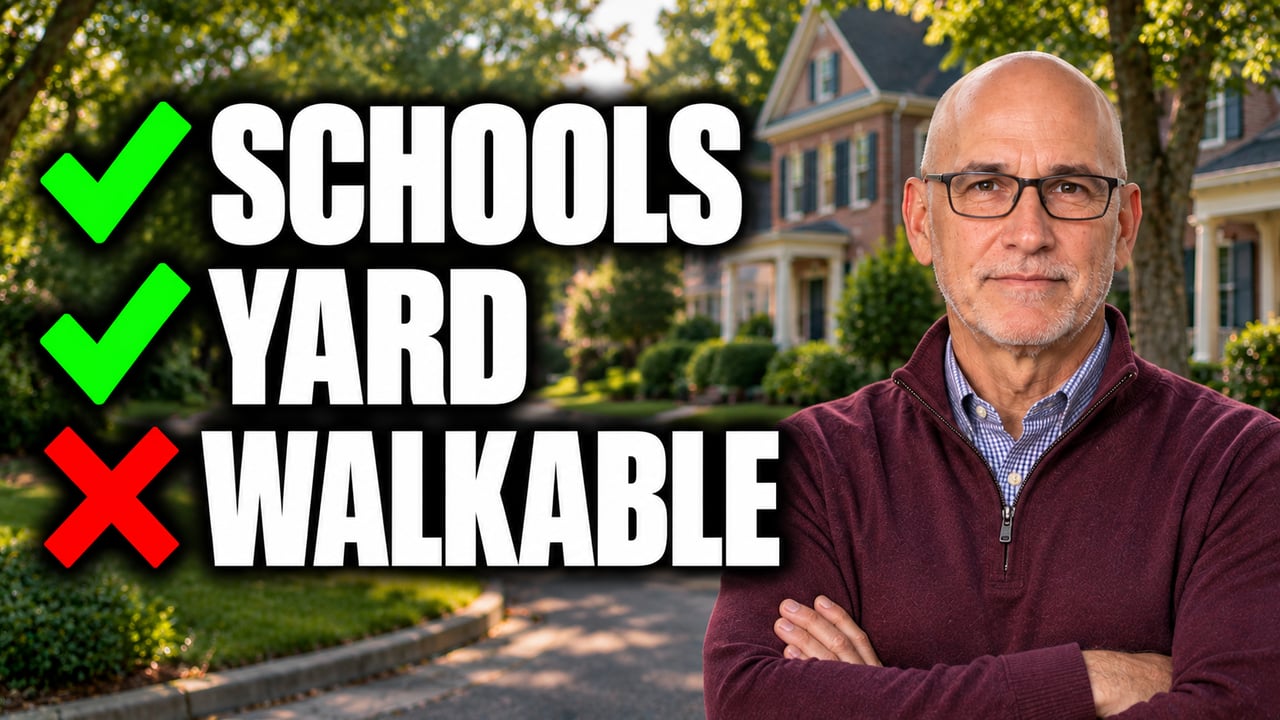
If you're looking for a home in Chapel Hill, you probably already know about the good stuff: great schools, UNC, Franklin Street, walkable neighborhoods, and a location that puts you close to just about everything in the Triangle.
But there’s one thing about living in Chapel Hill that can be harder to overlook.
The cost.
And it’s not just the price of the house. It’s the cost that keeps showing up year after year.
Is Chapel Hill Really That Much More Expensive?
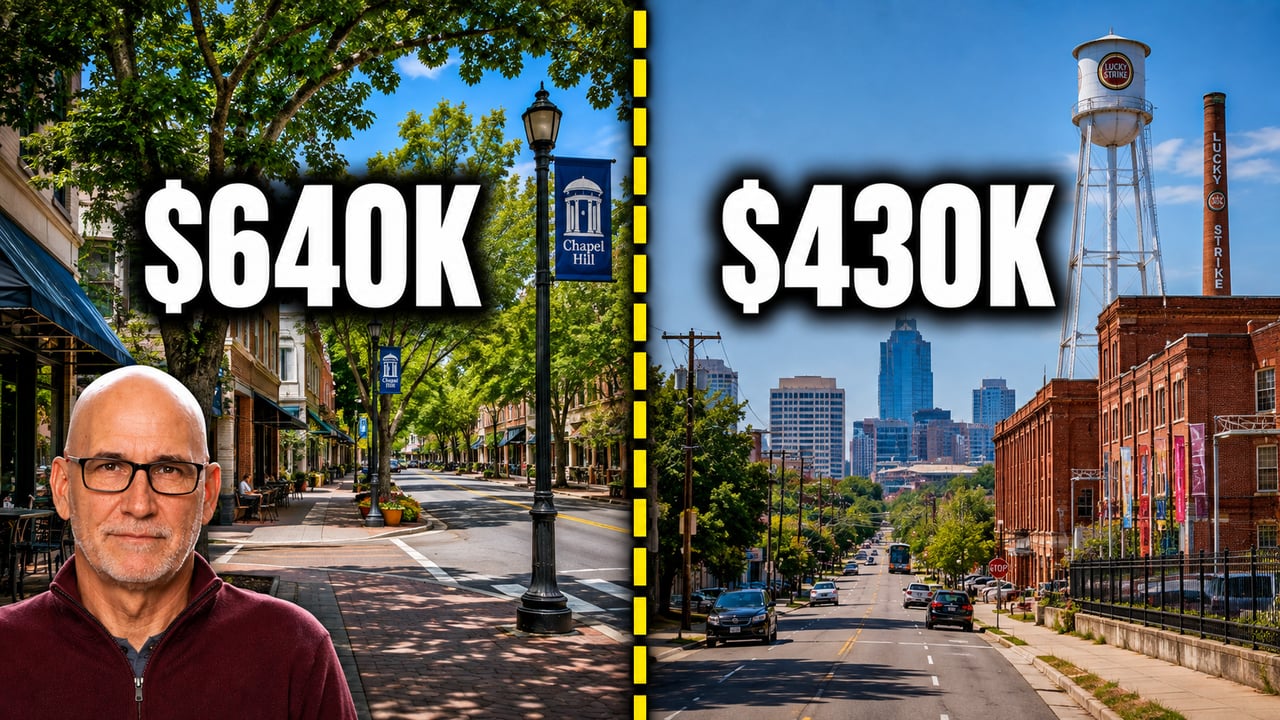
According to the numbers discussed in Bill Stevenson’s video, the median sold price in Chapel Hill proper was around $640,000 in 2024.
Now look just across the county line in Durham.
The Durham ZIP codes immediately adjacent to Chapel Hill — 27707, 27713 and 27705 — had a median around $430,000.
That's roughly a $210,000 difference.
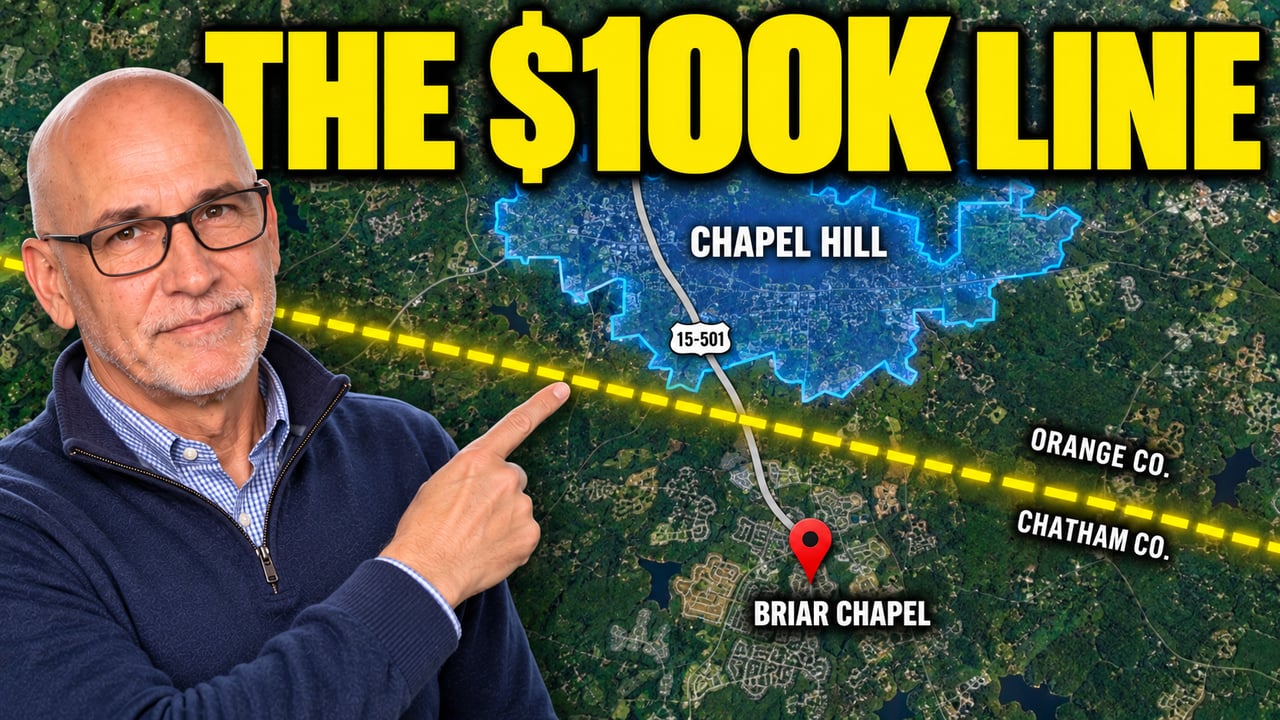
And here's the strange part: the county line isn't exactly visible.
There isn't a checkpoint. There isn't a sign saying, "Congratulations, your house just got $200,000 more expensive."
The neighborhoods on either side can have remarkably similar commutes, shopping options and access to the Triangle's major employment centers.
But once you cross that invisible line, the numbers can change significantly.
Then There's the Property Tax
The purchase price is a one-time expense.
Property taxes? Those keep coming.
Chapel Hill has a higher combined property tax burden than the surrounding areas discussed in the video. On a $640,000 home, Bill estimates roughly $7,300 per year in property taxes before adding the Chapel Hill-Carrboro City Schools district tax that applies to much of the town.
Compare that with a $430,000 home just across the county line in Durham, where the estimate discussed is around $4,300 per year.
That's approximately a $3,000 annual difference based on those example homes.
And over 10 years, that adds up to roughly $30,000 — before considering changes in home value, tax rates or the cost of financing.
Of course, taxes aren't the only reason people choose Chapel Hill. For many buyers, the school system is a major part of the equation.
And that's the point.
You're not just paying more for a house. You're paying for a particular community, school district and lifestyle.
For some families, that's exactly what they want.
So What Are the Alternatives?
Here's where things get interesting.
If you love what Chapel Hill offers but aren't sure you want the full Chapel Hill price tag, there are two nearby directions worth exploring.
Option #1: Durham
The first is Durham.
Move just across the county line and, according to the numbers in the video, you may see both a lower purchase price and lower property taxes.
That's a pretty compelling combination.
The trade-off?
Your address says Durham.
For some buyers, that's no big deal. For others, the Chapel Hill identity and access to Chapel Hill-Carrboro City Schools are a major part of why they're moving to the area in the first place.
There's also a different school landscape in Durham, with magnets, charters, specialty programs and private-school options that can give families more choices — although those options aren't necessarily interchangeable with Chapel Hill-Carrboro City Schools.
That's an important distinction.
Option #2: Chatham County
The second option may be a little more surprising.
Chatham County.
There are neighborhoods with Chapel Hill addresses that aren't actually located in Chapel Hill proper.
Briar Chapel, Chatham Park and Governor's Club are examples mentioned in the video.
In the example Bill discusses, Briar Chapel's median price was around $615,000 — only about $25,000 below the Chapel Hill median — while the property tax burden can be substantially lower.
That means you may be able to spend roughly the same amount on the house while paying considerably less each year in property taxes.
And you're still only a few miles from Chapel Hill.
For buyers who want newer construction, proximity to UNC and UNC Hospitals, and a Chapel Hill address without necessarily being inside Chapel Hill proper, this can be an interesting alternative.
But What Do You Give Up?
This is the part that's easy to gloss over when talking about saving money.
There is no magic loophole where you get everything Chapel Hill offers for half the price.
If you move to Durham or Chatham County, you're giving something up.
For some families, the biggest consideration will be the Chapel Hill-Carrboro City Schools district.
If that's the primary reason you're moving to Chapel Hill, leaving the district may not make sense simply to save money.
But it's worth looking at the alternatives carefully.
Durham has a wide variety of public-school options, including magnets, charters and specialty programs. And when you're spending less on the house and property taxes, you may also find that options like private school become more financially realistic.
That's a calculation worth doing rather than assuming one location is automatically the right answer.
Then there's the lifestyle factor.
Maybe you want to walk to Franklin Street.
Maybe being minutes from UNC is important.
Maybe you want to be close to UNC Hospitals.
Or maybe you simply like saying you live in Chapel Hill.
That last one might sound silly, but it isn't.
Where you live has an identity attached to it, and people place real value on that identity.
That value can also show up when it's time to sell.
So What's the Right Choice?
There isn't one answer for everyone.
If the Chapel Hill-Carrboro school district, location, lifestyle and community are exactly what you're looking for, the additional cost may be completely worthwhile.
If you're more focused on getting the most house for your money, lowering your ongoing tax burden, or exploring different school options, it's worth looking across the county line.
And that's really the point.
Know what you're paying for.
Don't just look at the list price.
Look at the property taxes.
Look at the school options.
Look at the commute.
Look at what matters most to your family.
Then decide whether the Chapel Hill premium is worth it to you.
The Bottom Line
The biggest downside to living in Chapel Hill isn't necessarily the traffic, the students or the town government.
It's the cost — particularly the fact that some of those costs continue year after year.
But if you love Chapel Hill, you don't necessarily have to choose between paying the full premium and moving somewhere completely different.
Durham may offer a lower purchase price and lower taxes just across the county line.
Chatham County may offer newer homes, Chapel Hill addresses and a significantly lower tax burden while keeping you close to Chapel Hill.
Neither option is identical to living in Chapel Hill proper. That's why it's important to understand the trade-offs before you make the decision.
And if you're trying to figure out which side of the county line makes the most sense for you, that's exactly the kind of conversation Bill Stevenson and the Spotlight Realty team can help with.
No hype. Just the numbers, the trade-offs and a clearer picture of what you're actually buying.