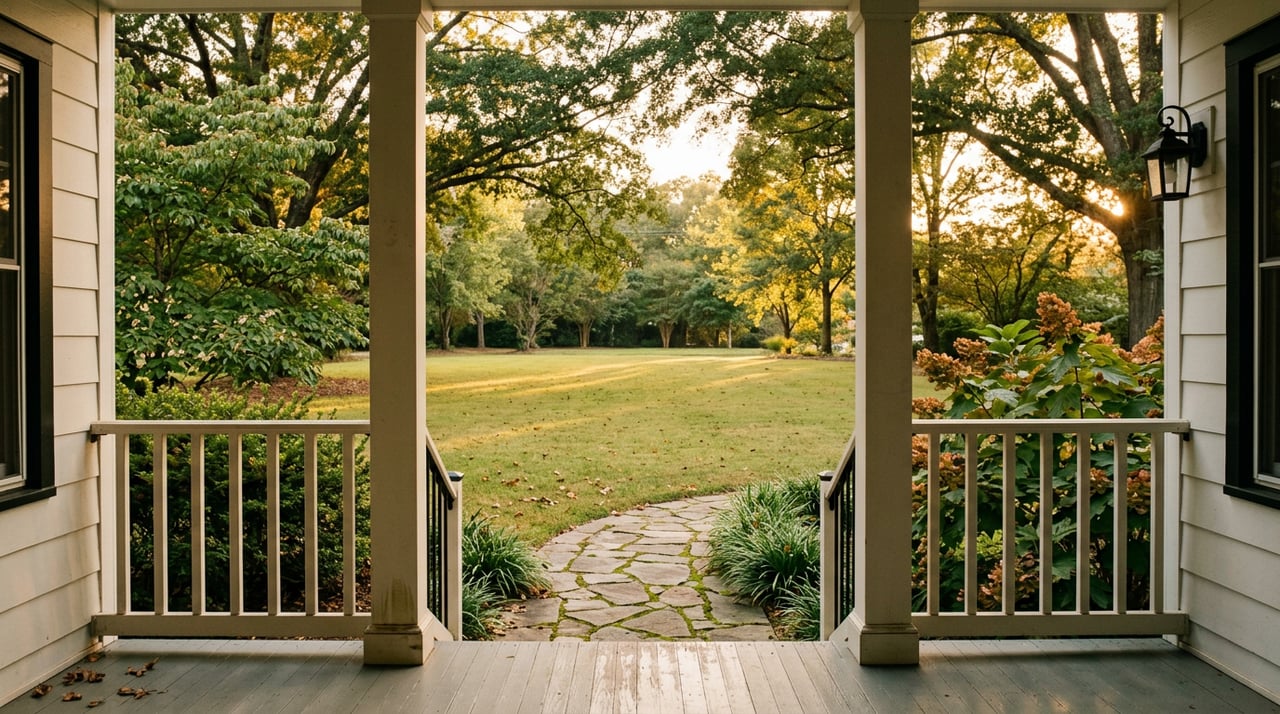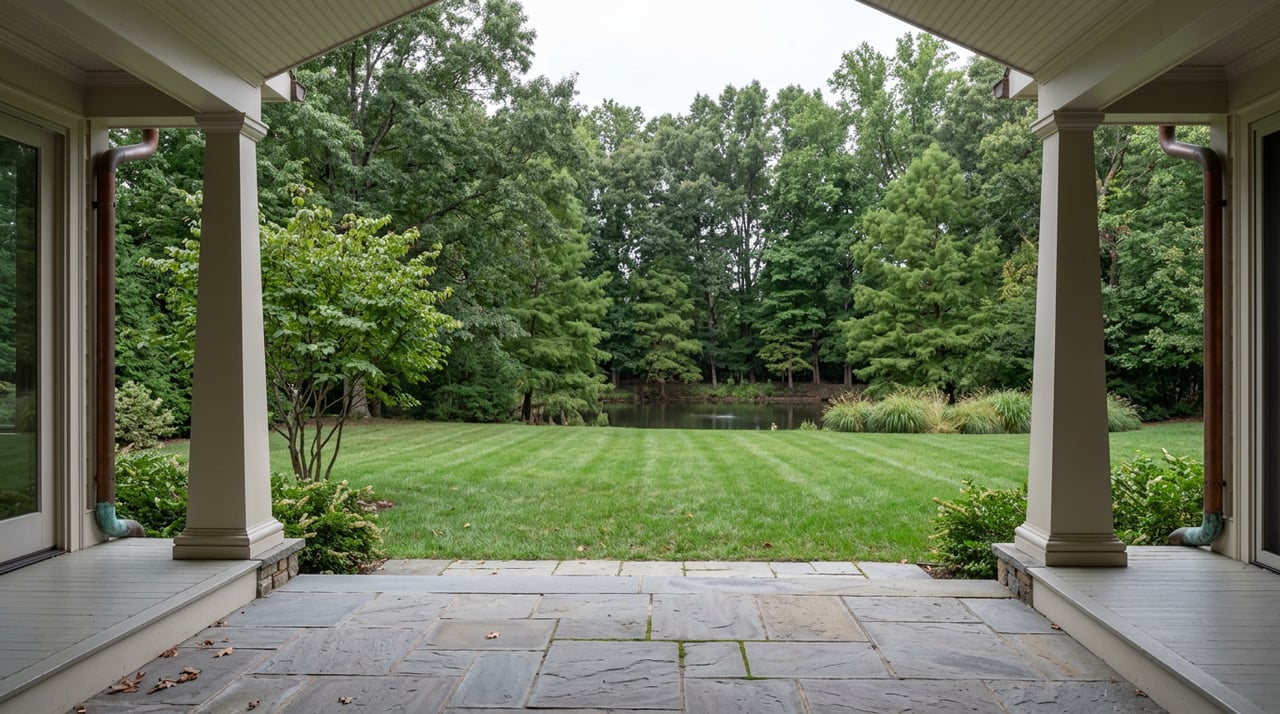
Walk the paved loop around Crystal Lake on a September evening and it reads like every other planned-community amenity in the Triangle: a twelve-acre pond, a covered fishing pier, a picnic pavilion with an outdoor kitchen, a trail worn smooth by strollers and leashed dogs. It feels like something a developer drew up in the 2010s and handed to an HOA. It isn't. That ground has been doing recreation duty since the late 1920s, long before anyone platted a subdivision around it, and the story of how it got there says more about how Croasdaile actually functions than any list of current restaurants could.
A lake that already had a job
The land under Crystal Lake and the surrounding Croasdaile Farm neighborhood has stayed in one family's hands since roughly 1900. In the late 1920s, the Moss family, who ran several amusement projects around Durham including the old Lakewood park, took a piece of that land and turned it into a recreation spot with swimming, a playground, and a small kiddie train, plus a rope-and-seat rig that pulled riders back and forth across the water. Through the 1930s it was a genuine local attraction. A decade later, soldiers training at Camp Butner, about twenty minutes away, used the lake for weekend recreation during World War II.
So when today's Crystal Lake at Croasdaile Farm neighborhood built its walking trail, fishing pier, and picnic pavilion around the same water, it wasn't inventing an amenity. It was reopening one. The development that followed decades later, led by the original owner's own great-grandson, simply returned the acreage to a use it already knew.
That matters for how you think about the ground you're walking on tonight. It isn't backdrop. It's been the neighborhood's actual gathering spot, under different management, for most of a century, well before this stretch of Durham was suburban at all.
The same pattern, a few minutes down the road
Croasdaile's golf courses tell a nearly identical story, and most residents only know half of it.
Croasdaile Country Club, the private club at the center of the neighborhood, was founded in 1966 on land inherited from John Sprunt Hill, with a course originally laid out by golf architect George W. Cobb and later renovated by John LaFoy. It's the version of Croasdaile golf that shows up in every neighborhood listing: gated, member-only, a fixture of local wedding photography.
A few minutes away on Hillandale Road sits the other half of the story. Hillandale Golf Course was established in 1911, also through the generosity of John Sprunt Hill, with its original nine holes designed by Donald Ross and the back nine by Perry Maxwell. In 1960 and 1961, the course relocated to its current site and was redesigned by the same George Cobb who would go on to shape Croasdaile Country Club a few years later. Two courses, one philanthropist's land, one architect's hand on both, and one of them stayed open to anyone who wants to walk up and pay for a round.
That's not a coincidence worth filing away and forgetting. It means the golf identity of this neighborhood was never really "private club with a public course nearby." It was one continuous stretch of Hill family land that got split into an exclusive half and an open half, designed by the same person, a handful of years apart.
Both halves have been reinvesting lately, on their own timelines. Croasdaile Country Club finished a bunker renovation in March 2024, added four dedicated pickleball courts, and opened a rebuilt pool facility in time for the 2026 season, with a new snack bar and covered deck overlooking the water. Down the road, Hillandale has spent this year rebuilding its driving range and practice greens, a full renovation that's kept part of the practice facility closed through the spring and summer. Neither club is coasting on its history. Both are spending real money on the same hundred-year-old ground.
If you've only ever thought of Croasdaile golf as "the club behind the gates," it's worth knowing that the course a few minutes away on Hillandale Road is actually the older of the two, walkable without a membership, and shares a designer with the one you can't get into. The posted rate for eighteen holes walking there runs under thirty dollars, a different kind of access to the same landscape George Cobb helped shape twice.
What this actually changes on a Tuesday
None of this is trivia for its own sake. It changes how you might spend an ordinary week here.
If pickleball is new to your routine, the courts didn't always exist. They're part of Croasdaile Country Club's 2024 and 2025 renovation cycle, alongside the rebuilt pool and bunker work, which means the club looks and functions differently than it did even three years ago. If you've been meaning to try golf without committing to a membership, Hillandale is the on-ramp, a public par-71 a few minutes off Hillandale Road, currently mid-renovation on its practice facilities but open for play. And if you walk Crystal Lake because it's convenient, it helps to know you're on ground that's been serving that exact purpose, recreation for people who live nearby, since long before the surrounding subdivision existed.
The rest of a Croasdaile week still runs through Croasdaile Commons on Hillandale Road, where the mix hasn't changed much and doesn't need to. Harris Teeter anchors the shopping center for the weekly run. For dinner, the options split by mood more than by distance:
- Bleu Olive for Mediterranean plates, lamb burgers and pork chops, with outdoor seating in the Commons
- Sushiō Bistro for sushi and Asian fusion when you want something fast and fresh
- Melo Trattoria & Tapas for Italian
- Picnic for Southern barbecue
- Thai Spoon for drunken noodles and panang curry on a weeknight
- Crafts & Drafts if the plan is a drink and something to make with your hands rather than a full meal
A few minutes further, Valley Springs Park rounds out the outdoor options with baseball and soccer fields, a playground, and a disc golf course, a different kind of recreation ground than Crystal Lake or either golf course, but part of the same pattern: land that keeps getting used the way it was meant to be used, just with new equipment.
The through-line
Every piece of this, the lake, the two golf courses, the park, traces back to a small set of Durham landowning families who kept returning the same ground to public use, generation after generation. None of it was built from scratch by a developer with a blank parcel and a rendering. It was land that already had a purpose, handed down, renovated, and in some cases split into public and private versions of the same idea.
That's a different way to think about a neighborhood than "here's what's new this year." The pool at the country club is new. The driving range rebuild at Hillandale is new. The restaurants rotate. But the ground underneath all of it has been doing this exact job, giving Durham residents somewhere to swim, golf, fish, and walk a dog after dinner, for longer than most of the houses around it have existed. Knowing that doesn't change what you do on a Tuesday evening. It changes what you're standing on while you do it.
If you're curious how any of this ties into what's actually happening with homes in Croasdaile right now, or you're weighing a move within the Triangle and want someone who knows this stretch of Hillandale Road as well as the market data, Spotlight Realty is a good place to start that conversation.